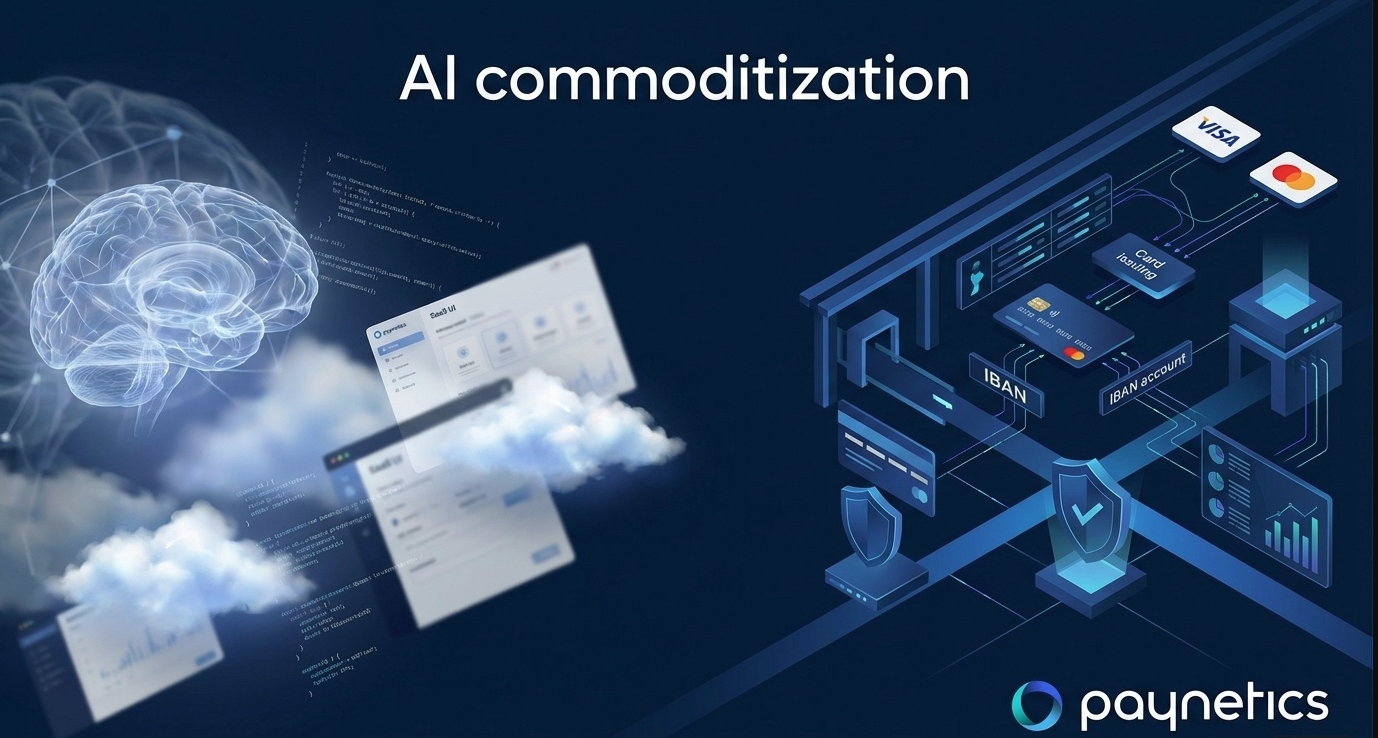

AI is turning software into a commodity. Embedded finance is turning SaaS into a business model.
Every investor pitch deck today talks about AI. But if you look carefully at what’s happening in markets right now, you’ll notice something uncomfortable: AI isn’t just accelerating software development. It’s quietly erasing the value of software differentiation.
Earlier this month Anthropic released a major enterprise AI suite. The market reaction was immediate. Software stocks sold off. Investors didn’t panic because Anthropic shipped a better chatbot. They reacted because the message was clear: high-quality software is becoming easier to build, easier to replicate, and harder to defend.
That moment matters far beyond AI.
It signals a new era for SaaS.
When Everyone Can Build, the Real Scarcity Becomes Permission
The cloud era commoditised compute. The AI era is commoditising execution.
The old SaaS playbook was simple: ship faster, build better UX, scale distribution, and protect margins with engineering advantage.That advantage is evaporating. When a small team can ship enterprise-grade functionality with AI assistance, the question for SaaS leaders and investors becomes brutally simple:
AI can generate code in minutes. But it cannot generate regulatory credibility.
In regulated industries, the answer is obvious: trust. Not “brand trust” as a marketing slogan. Real trust: compliance frameworks, licensing regimes, bank-grade controls, and the ability to move money safely across jurisdictions.
Regulation has not been rewritten for the AI era. It is still built for a slower economy, designed around human decision-making, long product cycles, and traditional financial institutions.That mismatch creates a new scarcity asset.
SaaS Is Quietly Becoming the Distribution Layer of Finance
Here is the trend most SaaS companies still underestimate. Finance is not moving into SaaS because SaaS companies want to become banks. Finance is moving into SaaS because SaaS already sits inside the operational bloodstream of modern businesses.
If you own the ERP system, you own invoicing. If you own payroll software, you own salary movement. If you own procurement tools, you own expense flows. If you own vertical marketplaces, you own collections and payouts.
Once you control the workflow, payments are not a feature, they are gravity. And once payments are embedded, everything else follows. Accounts to hold funds. Cards to spend them. Working capital to finance growth. Not as “fintech add-ons”, but as natural extensions of the software experience.
This is what embedded finance really means: SaaS companies stop monetising only through subscriptions. They begin monetising through the financial flows they orchestrate.
Why This Changes SaaS Economics Forever
Most SaaS executives still see payments as a plug-in. But payments are not an integration. They are a business model switch. The moment money starts moving through your platform, you move from being a software vendor to being infrastructure. You gain new revenue streams, yes. But more importantly, you gain something investors should care about even more: stickiness that compounds.
When your product becomes the place where money is received, held, and deployed, switching costs become structural. Your platform stops being “a tool.” It becomes the operating layer of the business.
The Companies That Win Will Not Be the Ones With the Best UI
In the AI era, every SaaS company will have a great UI. AI will help everyone build fast.
That means differentiation shifts away from product features and toward the things AI cannot easily replicate: regulatory rails, risk controls, compliance infrastructure, settlement capabilities, scheme access, licensing frameworks. In other words: the ability to embed financial services safely.
The more payments that run through the SaaS platform, the more proprietary transactional data it captures—data that becomes the foundation for precision-tailored, value-added financial solutions. This creates compounding differentiation, deeper customer lock-in, and a defensible moat that software alone can no longer provide.
The most valuable SaaS platforms of the next decade will be those that can move beyond software and capture the financial flows of their ecosystem. They will also likely be the ones that survive.
The Real SaaS Question for 2026
The biggest SaaS question is no longer: “How do we build faster?”. AI has already answered that. The real question is: “How do we stay defensible when software itself becomes abundant?” And the answer is not another feature. It is positioning. It is owning the transaction loop. Because in the AI era, the platforms that survive will not be the ones that write the best code. They will be the ones that move the money and keep the client. And embedded finance is how SaaS does that.